Welcome to Your Comedy Layover...

Washington D.C. may not be a city that embraces comedy with open arms, but you knew that already. That is why you found us. Here you can get information, interviews and insights on the best local stand-up, improv and sketch comedy this city has to offer... 4 Now. You can reach us at dccomedy4now(at)gmail.com. LET'S DO THIS, DC!
Showing posts with label guest blogger. Show all posts

Friday, May 23, 2008

Clickity Clack, Don’t Talk Back

by: Travis Irvine

I’ve done comedy on and off since 2003, and have lived and performed in cities such as New York, Los Angeles, London, Columbus, and now, Washington, D.C. Ironically, after all these years, I’m still not funny! Ha ha! See? Even that wasn’t that funny.

However, living in these different cities and doing comedy at various open mics has allowed me to study something a lot of comedians haven’t, and that is comedian cliques.

Yes, it turns out that comedians are as cliquey as cheerleader girls in high school…just less hot and not as boner-inducing. In fact, it’s kind of like being the new guy in high school: you show up on your first day; no one talks to you except a few other new people; you get put in front of everyone; you’re nervous; they judge you harshly because of your small boner; then reject you for the next few weeks until you do something so awesome and cool that all the girls think you’re neat and the guys want to beat you up because you’re going to prom with the head cheerleader. Small boners be damned!

[Hit the jump to read what Midwest city Travis thinks is a "comedy mecca". Hint: I am moving to Columbus, Ohio.]


In big comedy scenes, like L.A. and New York City, I saw different cliques for different open mics. One clique went to a certain set of open mics for the week and another clique went to another set. I experienced the same thing in London (no cliques of American comics, unfortunately), and saw similar situations while visiting Chicago and San Fran. In Columbus, a “veritable comedy mecca”, there was only one comedian clique because only five open mics existed, in addition to a weekly showcase at The Funny Bone. Even in a city not known for comedy whatsoever, it was the same deal for your first time: you show up and no one talks to you until they deem you funny and/or cool.

I’m happy to say that Washington has been the most accepting comedian clique I’ve experienced yet. Granted, I had a few friends already here, but overall, the scene offers the same opportunities as a big city with a smaller, friendlier core. One week you’re the new guy, and next thing you know, you’re eating mayonnaise in front of 10+ comics for shits and giggles…well, mainly shits. Ha ha! Now that was funny, people, come on!

What’s interesting is that if a certain clique does get good, then everyone in it makes it. This is what happened in L.A. with the comedians on HBO’s “Mr. Show”, or with the comedians from “The State” in New York, and of course, with the “Second City” crowd of Chicago in the ‘70s. If a collective group of people gets funny to the point where people can’t not pay attention, everyone in the clique goes along for the ride! Yahoo!

So I say, embrace the comedian cliques you will encounter from here on out, and understand it’s all just part of the process. If you’re really funny, eventually you’ll be eating mayonnaise and fucking the head cheerleader so hard it won’t matter how small your boner is. Ha ha! Callback city! Anybody on that one? No? Okay.

Read more!

Thursday, May 8, 2008

Bitching About People That Bitch

By: Danny Rouhier

You've heard them. You've been at a show when they are bitching about not being able to get on stage. You've heard them complaining about how a certain guy books his show and how it isn't fair. You know who I'm talking about. It's the guys who think they are entitled to something simply because they've told their co-workers and friends 'I do comedy'.

The people I'm talking about are not necessarily bad people. My argument is that they just don't realize how selfish and short sighted it is to bitch about how someone books their show or complain about not being able to get up. Someone might post a counter to this about how comics need an opportunity to get better and it isn't fair if the bookings they want constantly are going to the more established comics while they are left to wonder why.

To quote Jack Nicholson from the Departed: 'No one gives it to you. You gotta take it.'

[hit the jump, bitch]


Let me be clear about something. Performing comedy is, inherently, a dependent art form. In order for one to perform somewhere successfully, a comic is dependent on several factors (booking, venue, audience). At no time, from a guy who is going on for the first time all the way to Brian Regan/Bil Burr, is a comic entitled to anything. He/she should consider it a blessing every single time all the right things happen to allow for a successful performance. It's even more of a blessing once all those external factors allow you to make a living doing something as trivial as standing on a stage, speaking into a microphone at a glorified diner/bar. Comedy clubs make money by selling food and booze. It's nice when they take an active interest in the comedy community by developing and showcasing talent, but it certainly isn't the norm. We as comics need to remember that there are more ways than ever for people to spend their entertainment dollar. We often overestimate the market for live comedy. It's way too easy for consumers to get their entertainment from a myriad of mediums for us to presume that people will just show up at the venue we will be performing at without any work being put in.

Having recently left the DC scene and moved to New York City, there are a number of differences. The most glaring departure I have seen thus far is that the majority of comics up here seem to understand the idea that you have to create your own breaks. If you want stage time, start a show. Your level of involvement is up to you. You can do 0 work, have your show last a couple months, get it canceled and start anew. You can put in a ton of work, build it as best you can, still have it canceled and move on. The point here is that I bet that most of the guys who are pissed off at what they perceive as a small group getting all the work, haven't done near as much work as they think they have. How many shows have you started? Have you gotten a room going so that you can exchange stage time with someone else who has a room? Have you put in work pounding the pavement finding a a great venue where you can eventually get comics some $ for performing? Have you taken it upon yourself to stop waiting for someone to give you something and gone out after it yourself?

No one is responsible for getting you stage time. It's up to you. Instead of bitching about not being able to get on a show, go make a better show. Take responsibility for your own destiny and stop bitching.

Read more!

Thursday, April 24, 2008

The Tyranny of the Majority

By: Jeff Maurer

Andy Kline recently wrote an excellent blog about “genre shows”— shows that play to a specific comedy niche. I recommend that you read the whole blog, but, basically, his point is this: genre shows hurt comedy because they allow comedians to hide from challenges.

Andy’s complaints about genre shows are dead on. Most genre shows are obnoxious. They’re first and foremost about reinforcing the audience’s identity. Moving merchandise is the second priority, and launching terrible movies is the third; providing good comedy is maybe seventh or eighth on the priorities list. And genre shows are only part of the problem—more and more these days, comedians are selling themselves as genre comedians. Think of some of the comedians who have gotten really big in recent years: one is the redneck guy, one is the frat guy, and one is the Mexican guy. The fact that you don’t need their names to know who I’m talking about just goes to show how much their identities overshadow their comedy.

But the self-segregation of comedy is only part of the story. Andy calls out genre shows, then discusses how comedians used to challenge themselves by “crossing over”—playing rooms that draw different types of audiences. He’d like to see more of that nowadays. That’s where he and I differ. I don’t like genre shows, but I’m also not eager to return to an era in which comedians are obsessed with crossing over.

[Hit the jump for more thoughtful deliberation! Do it!]


Here’s what I think of when I think of crossing over. A few years ago, I was emceeing in a Def Jam-type room. Please note: “Def Jam” is not a euphemism for “black.” “Def Jam” is a euphemism for “combative.” To explain this to non-comedians: black crowds are like white crowds; they come to a show to see comedy, and they give bonus points for comedy they find relatable. Def-Jam crowds, however, aren’t there for comedy at all: they’re there to judge the comedians. They use the first 30 seconds of your set to decide whether they love you or hate you, and they use the remainder of your set to either cheer you like a war hero or boo you mercilessly. I got booed all week.

After one particularly rough set, I brought up a guest act. I had met the guest act briefly before the show; he was a non-descript white guy from California wearing a baseball hat. But that wasn’t the comedian who came to the stage; the comedian I brought on stage was a strutting, swaggering jack-ass wearing a backwards baseball hat and speaking with what I call the “MTV accent.” His first joke was about how bad I was. His second and third jokes were about whitey. From there, he did some of the hackiest, dirtiest crowd-work I’ve ever seen, culminating with this line: “I’ll bet black women’s pussy taste like fried chicken!” He was a god—the crowd absolutely loved him. He had successfully crossed over.

In comedy, this man will judge you.

Now, I’m positive that Andy isn’t advocating this type of comedy when he encourages comedians to cross over. That story is an extreme example. And Andy isn’t encouraging comics to play different rooms so that they can pander to the audience; he’s encouraging comedians to challenge the audience. But I think an implicit part of Andy’s argument is that crossing over makes you a better comic because you’re forced to learn the tastes and preferences of different audiences—you learn to adjust. And that’s all fine, but I think that this also needs to be said: there have to be limits on how much a comedian changes him or herself to please the audience.

As many comedians have noted, comedy mixes styles and genres more than any other form of entertainment. Most comedy shows are advertised only as “comedy”—no other form of entertainment does this. You’ll never see a Cineplex marquee that just says “Movie!” No concert has ever featured four unnamed musical acts that turn out to be a metal band, a rap group, an opera singer, and a country jamboree. But this type of thing happens all the time in comedy. The range of tastes that comedians are expected to satisfy is already ridiculously broad.

It isn’t good for comedy when incredible breadth is a prerequisite for success. We had that atmosphere once, back in the 1980’s. Back then (and, obviously, I’m relying on the recollections of people who were actually there), there was only one way to make it: you got on The Tonight Show, and if Johnny waved you over to the couch after your set, you were in. Of course, The Tonight Show, even then, featured very broad humor; remember, it was the only game in town for the entire country at 11:30. So, basically, you either wrote jokes that appealed to everyone in the country—including 14-year-old boys, 60-year-old widows, soccer moms, drug addicts, and everyone in between—or you didn’t make it. Period. That’s unbelievably constrictive.

To be fair, that era produced some truly great comics. But it also produced a remarkable number of hacks. Remember all the guys in sweaters doing observational humor on Evening at the Improv—the comics Jerry Seinfeld made fun of on SNL’s Stand Up and Win sketch? Those were all guys who were trying to get on The Tonight Show. When comics try too hard to be all things to all people, comedy gets limited to the five topics to which everyone can relate: TV, work, dogs, relationships, and air travel. It’s pretty bleak.

What’s the deal with this thing? Do we really need this much Mountain Dew?

But the hacks don’t bother me as much as the true tragedy of the 1980s system: all the great comics who didn’t make it. The system back then put so much emphasis on breadth that there wasn’t much room left for comics with a great deal of appeal to a narrow segment of the audience. When I ask myself whether a lot of my favorite comedians—such as Paul F. Tompkins, Eddie Izzard, and Todd Barry—would have made it during the 1980s, the answer is probably “no.” They just aren’t broad enough. If the Balkanization of comedy is bad because it rewards jokes that aren’t funny, then the homogenization of comedy is bad because it punishes jokes that are funny.

That’s not only unfair to the comedians—it’s also unfair to the audience. Putting aside your opinion of Kat Williams for a minute, ask yourself: who was the Kat Williams of the 1980s? I don’t think there was one. Or, more accurately, there probably was one, but we never heard of him because he wasn’t broad enough to make it on The Tonight Show. There is obviously a market for Kat Williams’ humor; it just happens to be a deep, narrow market instead of a broad, shallow one.

The Maria Bamford of the 1980s.

Of course, Andy and I aren’t actually very far apart on this issue. I don’t think that Andy is arguing for homogenization; I think that he wants comics to challenge themselves, and he’s also reacting to the arrogant “I’m above the audience” attitude that some comics adopt. And I agree with both points. Comedians should challenge themselves—anyone can make their friends laugh, but comedians are supposed to be able to make strangers laugh. And a comedian should always go onstage with the goal of making the audience laugh; if you want to create high art, go write a symphony. Comedy is entertainment.

What I’m advocating is essentially a balance. Comedians should challenge themselves by trying to make different types of crowds laugh, but they should stay within the parameters of their actual personality and taste. And I’m okay with genre shows, but only if the comics use the opportunities those shows provide to produce quality comedy instead of pandering crap.

Andy ends his blog with a music analogy: Nirvana, he says, made great music because they weren’t afraid to challenge their audience. He’s right, but there’s more to the story. Nirvana became Nirvana because they didn’t care about cultivating broad appeal. Seattle in the late ‘80s was a second city without a lot of “industry” floating around (sound familiar?). There was no hope of making it, so there was also no point in making the type of music that was likely to get you a record deal. So they made the type of music that they liked, and it’s a good thing, too: Kurt Cobain probably wouldn’t have been any good at teasing his hair and playing virtuoso guitar solos. There was a segment of the population that was never going to like them, and they were fine with that. Which is something that comedians should always keep in mind: after all, during the best set of your life, 20 percent of the audience hated you. In comedy, you can’t please all the people all the time. So, fuck it: don’t try.

Read more!

Friday, April 11, 2008

Not Hating Just Saying: DC Comedy: 4 Now


Guys, I'm so happy! What do I love? Life and all of the beautiful creatures inside of it. Which is why I'm so glad I found this blog on Gawker this week. It's all about not hating on things and just saying stuff! Isn't that what this world needs, a blog about just straight up loving your common man? I agree. Which is why I couldn't have been more excited when they deemed us worthy enough to write a blog entry about! Oh my, we here over at DCC4N have never been this excited about the possibility of greatness in humanity. I actually haven't read it yet because I was so excited to share it with the world. So here it is...

Not Hating, Just Saying: DCC4N!
I'm not hating on DC Comedy 4 Now, but what the hell were you thinking? You kindly asked us to do a guest blog hating on you and your site!? We can barely contain ourselves. The funny thing is we already hated you! In fact, we had already written like 90% of this post. Our original plan was to hack into your site by figuring out your password which we are sure is probably something like "IthinkIm2good4DCbutIwillbeinDC4ever" and just put up the post ourselves. But thanks guys, thanks a lot 4 giving us the opportunity to shit all over your site…even though pretty much everyone is already shitting all over your site behind your back; but we are really glad that you are letting us bring it to the 4front. Maybe you can learn a thing or two about not hating on stuff.

[Hit the jump for more hate you can appreciate.]

Now be4 y'all get all pretentious with comedy and all your "success"...why don't you, oh, I don't know...get a "gig" doing comedy? You know what that is? Where a club will see you per4m and "like" your "jokes" and ask you to do more. 4 money! I know this is a crazy idea. I know you're all into the "art" of it all. And any sellouts who do something as shallow as get "paid" to do their art are probably hack comedians, and shouldn't be referenced on your site. But why not give it a try? Who knows, you might like it?

In fact, with that money, maybe you could pay to get some bigger names 4 your "Spotlight" posts. My favorite part is when you ask why they first tried stand-up. You should change that question to "Why did you have some free time 4-to-six months ago?" Don't worry―you'll get the exact same answers.
I'm not hating, but honestly, what kind of spotlight are you using...because the "stars" you're getting aren't all that bright. Is it burnt out? What is it― six, eight watts max? As much as I love to hear the expert opinions of a 20-set vet, maybe you could go ahead and wait until that kid you play "RockBand" with has a little more experience be4 you give him the "honor" of being "worthy" of being "spotlighted" on your "website" run by "comedians" who tell "jokes" that are "funny" and make an "audience" "laugh" "without" being "encouraged" by Nick "shouting" at them. Oh, sorry, we put too many quotes in that previous sentence. Some of them weren't needed―Nick really does literally shout at audiences.

The "spotlights" are so weak that you even have "spotlights" on all 3 of us! I have to say we had a hard time answering the questions because no one has ever asked us those questions before, because I am pretty sure that no one really gave a shit about what we had to say, and that is mainly because no one knows who the hell we are. How did you get the scoop on how John McBride's parents felt about him doing comedy before the the Washington Post did? I know they were all over that story! The weird shit is you guys do get legit interviews sometimes: Todd Barry, John Mulaney, Ted Alexandro...but then you follow it up with Bryson Turner AND Seaton Smith! That is senseless.

Really though, do you even have an actual "spotlight?" Or do you just use your cell phones as your spotlight, like you use it to light all the comics after their awkwardly silent 5-minute sets at your open mics at Chief Ike's, where DCC4rest-of-this-bulky-and-burdensome-acronym really draws its "multitude" of fans. Clearly this site is thriving when you can't even get people to go somewhere 4 free.

And it's not even just free! People who go to your shows actually get something, and you still can't get anybody to come! What do they get, you ask? Well, a lot of them get some really valuable in4mation regarding some inventive uses 4 cooking oil. Oh wait, that's not a good thing. No, but not only does that 70-something creepy lady in the red coat keep showing up to your guys' shows, but none of you will even admit that she's with you. Look ―so things aren't going that great 4 you in life, socially speaking. That doesn't mean you should be ashamed of who you're with.

And I think of all the people involved with your site, Aparna is the one we hate most. You know why? Because there is absolutely, undoubtedly, unequivocally, without question....nothing whatsoever to hate about Aparna. Believe us―we tried. We spent days trying to come up with some hate 4 her. Nothing. She's unhateable. It's like trying to hate on a fluffy blueberry muffin that spends its days feeding the homeless and nights hugging child burn victims. You can't hate her. You just can't. Do you know how bad that makes us look, as the ultimate deliverers of hate (non-haters division)? Terrible! That's why we hate you, Aparna. Because we don't. And that's the worst type of hate (But not really―we love you! We hate it, but we do).

And what about Jay Hastings, you ask? I feel like this is the point in the post where we reference a scene in one of those animated tv shows. You know the scene, when someone is so evil, that they meet up with the Devil, and you expect the guy to be really scared of the devil, but instead, the Devil gets really intimidated and is afraid of the guy and tries to kiss up to him like he's the Devil's boss? Well, I guess we're the hating devil, and all we have to say is...is there anything we can do 4 you? Coffee? Danish? Anything at all, sir? But seriously Jay, we love how you masterfully weave in racism and homophobia to your jokes when it's not even necessary. It's not even hating when you do it…It may actually be the only time where people feel sorry for the person being racist or homophobic. "Awww did you hear that? Poor little guy, he still thinks words like 'faggot' are funny."

And Jason I have this set at the DC Improv, can you do me a favor and let everyone know you walked out on it but still found the time to critique it? Please? I mean in your standup comedy experience that equals that of the time it takes to heat my coffee in a microwave, we wonder at Not Hating how it is you were able to sit through ten minutes of a twenty minute set of the opening act, and not be able to sit through the next half and watch Bill Burr. We were baffled to come to a conclusion; is it drugs or sex or both? No, we figured it out. You must have not realized that feature acts are only onstage for 20 minutes. Maybe you got your feature and headliner title mixed up, and you thought he was gonna do an hour. Cause it's just sad you couldn't sit for ten minutes. TEN MINUTES. You could have done anything to pass the time of ten minutes. I mean you could have walked in the lobby; made a phone call; called your aunt whom you haven't spoken to in years; made a play date; updated the resume; or stood in line in the bathroom, and jerked off in the stall, cause you sure as hell jerked off on your blog entry the next day.

Oh and Nick Turner, what's going on with him, you are wondering. Well, hell if I know, nobody does. You can only find him at one of the shows that he puts on. You know it's funny…you don't ever see him out at anyone else's show…I mean it's not because he isn't getting booked…right? I mean he's Nick Turner! The man who came down from New York to save the DC scene right? Wait…why the hell did you go from New York to DC? I've heard of alternative comedy be4, but not really alternative career choices. I hear all the aspiring actors are moving from LA to Omaha so they can really get their careers back on track. What's your next blog Nick? Bangkok Comedy 4 Now? Well, we can only hope. Have fun trying to get booked out there; I hear the Thai don't like being yelled at.

But seriously, way to go guys. Great site! I mean, you know, we're not hating, DC Comedy 4 Now, we're just saying.

Love,
Not Hating Just Saying

Read more!

Friday, April 4, 2008

The Side That's Winning

By: Andy Kline

The first time I ever did stand-up comedy was back in 1994 at the age of 19. I did it basically as a hobby for about two years, then drifted away. In the spring of '98, I came back into it full force. I don't remember the exact date, but I think my first time ever on stage was the last Wednesday in March, '94 - about a month after Bill Hicks died, and about a week before Kurt Cobain did. The number one song in the country was "Wet Banana" by The Floaters, a loaf of bread cost -12 cents, and only the wealthy had knees.

To characterize DC comedy as a "scene" back then would be a disservice to the word. There was no scene. It was just a collection of comics doing a few open-mic's together. There was adequate stage time, but not much in the way of ambition or identity. The word most frequently used when discussing comedy wasn't hack, or original, or unicorns. It was crossover. Everybody was talking about crossing over.


There were a lot more black rooms in DC back then. If you were white and wanted to get on stage more than once or twice a week, you would have to venture out to Mr. Henry's in Adams Morgan, or one of the Comedy Connection rooms. You would have to risk getting booed or heckled. You would occasionally have utensils thrown in your general direction. Likewise, black comics looking for time would have to hit The Comedy Café on K Street, or Headliners in Bethesda. They would have to risk getting ostracized by the pervasive "Def Jam" label. But, we all tried to cross over. It was important to relate to unfamiliar crowds. It helped you grow. Sure, some people did it in a hacky way, but most of us had a fair amount of integrity.

old school comedy
photo courtesy of
Flickr and timparkinson

Historically, that's what comedy has been – people crossing over. Just look at the way comedy is marketed. The majority of comedy bio's you read say, in essence, that this is someone who is different from you. From a different background than you. With a unique slant and fresh perspective on the world. If you believe what you read, there are literally thousands of unique slants and fresh perspectives out there, playing every out of the way Hysteri-Hut and Tickle Trap in the country. The message a comedy crowd is given is this: you won't agree with everything this comic says, but he'll show you what's funny about his point of view. Not that comedy audiences have ever fully embraced that message, but it's essentially what they're told.

But, comedy has been changing for the last few years. It's being splintered into all kinds of various genres. Somewhere, on any given night, you might find yourself at an alternative show called, "Grown Men Who Still Watch Cartoons." Or maybe an urban show called, "Somebody Say Ha." Possibly even an all-female extravaganza called, "The Drapes Match the Rug-Pulls." In every city that has a comedy scene, comedians are banding together in neatly packaged little groups: the black show, the not-like-the-other-blacks show, the redneck show, the Arab show, the alternative show, etc. In some ways, it's no different than developing a hook; the "GIT-R-DONE" it's okay to like, if you will. But in other ways, it's killing people's growth.

this set up killed at the Trekkie convention
photo courtesy of
Flickr and Idea-Listic

The crowds at a genre show are agreeable. They don't challenge the comedian, and the comedian doesn't challenge them. And that's the dirty little secret: you don't have to be that funny anymore. They like you because of what you represent. If you're an alternative comic, you can get away with dropping transformers references and displaying fake creativity by talking about genies and robots and elves. The crowd is there to root for you. You're a cause more than a comic, and this is your pep rally. The same can be said for the black comic leaning on the white-guy-voice on urban night, or countless other examples. Genre shows advocate indulgence. And they stifle growth.

It's just like a national headliner who finally gets his own audience of devoted fans, then winds up catering to them completely. Listen to Sam Kinison's CD Leader of the Banned, if you need a reference. By the time it came out, he had reached a point in his career when he could just yell FAGGOT into the microphone and his crowds would cheer. His bits got lazy and the comedy suffered, yet he still destroyed (he did find his roots again on Live From Hell). Check out Dane Cook's Vicious Circle special. Not that he has ever been a good comic in my opinion, but that special lacked any creativity or imagination. It was a bunch of shared-experiences done with energy and an arched back. And his fans ate it up. Have you ever watched a Margaret Cho special and wondered what the hell everybody's laughing at?

Now, those comics had years of experience in comedy, and they still couldn't resist the temptation to indulge and cater to their crowds. But, what if you're a brand new comic who latches onto one of these scenes? You've just started comedy and you already have what is essentially your crowd. What happens when that crowd forgives your mistakes and laughs extra hard anyway? Well, what happens is a generation of thin-skinned comics who lack polish and development.

Bill Burr wrote a blog, roughly a month ago, about his early days in comedy. He mentioned that, once he found his voice, he deliberately went up in front of audiences that were hostile. That may have come as a revelation to some, but really, that's how everybody used to think. Things are so different now.

I've heard so many new comics write off a crowd because they were too old, or too rowdy, or too black. I've heard people bad-mouth crowds at A+ rooms, like the Improv, by snidely calling them "mainstream." It sounds to me like people are afraid to bomb, and they're sheltering themselves completely from that experience.

everyone can relate to nudity, am i right?
photo courtesy of
Flickr and Arbron

I deliberately mentioned Bill Hicks and Kurt Cobain at the beginning of this blog because they were two artists who constantly challenged and confronted their crowds. So does Bill Burr. Part of what makes stand-up comedy great is that it gives performers the ability to take real risks and provoke their audience. I feel like that ability is being traded in for safety and support.

I don't think the current direction of comedy is all bad. There are obvious benefits, and, if approached the right way, having a receptive crowd can be a great thing. In fact, my biggest hope is that this trend will lead to an established underground comedy scene, similar to what you see in music. The current power structure in comedy doesn't represent or expose the right people most of the time, and other avenues are sorely needed. But, does anybody even use the word crossover anymore? Does that idea even cross people's minds?

Read more!

Monday, March 24, 2008

Dr. Heckle and Mr. Snide (Comments): Part 2

[Last week, we posted on the topic of hecklers and how to deal with them. Today, Hampton Yount brings the topic up again with his insights on the many faces of the interrupting douche/heckler. Enjoy.]

Hampton here again, ready to bring you new emotions through printed word. Let’s cut to the chase. I made a list of the different kinds of hecklers I have seen or heard about. One of my secret pleasures is writing up lists: Favorite movies, favorite songs, and least favorite memories. If a really eccentric criminal threatens to put me on a desert island, I know exactly which five best Weezer solos to bring. So, in that tradition, I have decided to shine a light on comedy and list the different types of hecklers.

Note: All of these categories are made instantly more annoying if they are a girl. Award them five hundred Fran Drescher points! Herewego! (read that real fast…real fast)

The Oblivious
I’ll start with the one that is less a standard heckler but more of an annoyance. This is the guy who doesn’t realize a show is going on. Well, don’t be mad at him; it’s not like you’re on stage with a microphone sending your voice over a PA system. He probably thought God was trying to talk to him, and he lost his faith years ago (Too little too late, God!) The best is when you stop talking or draw attention to this character, and they act like you are being a jerk. I once got a “Sorry” so dripping with sarcasm that I used it as lubricant and jerked off with it. That’s how much I loved that moment.

The Idiot
This one might actually be my least favorite. This is the guy who shouts things that are neither good nor bad about your bit. It’s rare, but it makes me slit my mental wrists every time. I’ll give an example; I have a joke about Battlefield Earth (so fucking funny, I’m a genius!), and on several occasions, I have had someone shout loudly, “JOHN TRAVOLTA!!!” midway through my bit. Frustrated, I asked one of these guys “What about him?” and he said “He’s in the movie.” I then shouted at this man for several minutes.

[Hit the jump! He's on to something here, guys!]


The Helper
This is the one you hate to hate. He shouts stuff out with the intent, in theory, to help you. Either that or he laughs weird. He’ll shout something like “You are so funny!” or have a weird, show- stopping cackle (In all the cases of the weird cackle, I wanted to stop the show and PAY to watch the person laugh). The problem is that it can make you mad, but you have no idea where to place that anger. You can’t yell at the person because it feels weird to say, “Stop having fun!” The only solution is to hug the life out of him.

The Corrector
I think you’re getting the trend here; this is the person who tries to correct your joke. Usually you’ll quote a fact or make an assertion, and they want to make sure the audience isn’t made dumber by your slight misstep. Well, how fucking helpful! No, their help couldn’t have waited until after the performance. They need to make sure everyone knows John Goodman is actually a Virgo, you blasphemer.

The Impresser
Finally, a category truly worthy of hate. He is the pinnacle of douchebaggery, the guy who shouts things to impress his friends/date. His parents were two bullies who stopped punching each other long enough to look in each other’s goofy bully eyes and breed on top of a gym mat. Nine months later, they gave birth to something with no manners. The worst is that after this guy shouts something, he goes for “The Confirm” with whoever he is with, and is greeted with sycophantic smiles. Suddenly, your head drowns in memories of high school; how him and his posse laughed at your awkward boners. Not at mine though! I was awesome in high school! I had lots of cool friends, and I was voted Class Boner. Digression aside, The Impresser is just upset someone is funnier than he powerdreams he is. I recommend comparing this specimen to a type of failure. The balance has been restored.

The Leader
This is the heckler whose comments are dead on. He is speaking on behalf of the audience, and you can feel it in your pores. Fear this heckler; he is your doom. In an ancient primeval way, this heckler's scent has claimed dominance, and is verbally hitting you in the face with a femur while the audience/apes flap their arms in approval and hurl feces (the tomatoes of the ape world) at you. Maybe it’s time to rethink career choices.

Any more that you can think of?

Read more!

Monday, March 10, 2008

Improvisation Meets Stand-Up Vol. 1

by: Mike Blejer and Jason Saenz
First up: The Stand-Up Comic, Mike Blejer

Full Disclosure:
I’ve done some improv over the course of my life since I’ve been involved in acting from about the time I was 8 or so, but in the context of comedy I did mostly sketch in college and then writing a satirical blog for a magazine after school before I started doing stand up. My point is, I’m going to be making a lot of assertions about improv and stand up and I’ll own up to my lack of in-depth experience with improv now. Feel free to use that to discredit me without really considering the strength or validity of my argument.

The Gripe:
A lot of comedians I’ve seen perform bits that could just as easily be done in improv. For instance they take a two things that are wildly different and juxtapose them in an obvious way and then act out “what it would be like.” (e.g., What if, Captain America went to the Laundromat!?! ‘What is this, steel mesh?! I ain’t steam-cleaning no shield!!’). This isn’t inherently a bad thing, but I just think that stand up comedians should aspire to do things which people can’t do in improv, to play to the strengths of their chosen medium.

So because stand up material is practiced beforehand1 you should be able to do things with it which you just can’t do with improv. This could mean going into a subject matter in greater depth (what is typically thought of when depth is discussed), but it could also mean exploring a concept with more subtlety than would easily be attained in improv. For that matter, it could be structuring a bit with more depth, the most conspicuous example is probably a call back (which also occurs in improv, but again the subtlety factor can be a big differentiator here), but in addition to call backs, there are more interesting structural benefits that can come from prepared material.

[For the rest of Mike's take on Improv and Jason's counterpoint hit the JUMP!]


Comedy Autopsy:
Bryson Turner has a bit he’s doing right now which provides a really good example of this. I will try to paraphrase the joke as best I can2:

Premise/Observation: They sell regular and large sized condoms in stores, but not small condoms. “They have every other type of condom except small condoms. They even have mint-flavored condoms, and I highly doubt there are women out there saying, (Act out) ‘man...i wish there was something that made my mouth feel really clean and really dirty at the same time.’”
Normal explanation/set-up: No one wants to have to publicly admit they have a small penis by buying one. (Act out: “Hey can I get price check on a 12 pack of mini-P’s? Yeah, the ones for people with small penises. Over in Isle twelve. For this guy.”)
Alternate explanation/Twist 1: A man with a small penis doesn’t really need a condom anyway, because if he’s gotten a woman to agree to sleep with him despite his ‘shortcoming,’ he’s obviously cunning and resourceful enough to get out of using a condom anyway. (Act out?)
2nd premise/Twist 2: This is why I think MacGyver had a small dick.
Development/set-up 2: (act out) Girl to Macguyver says “what should we do, all I have is this saran-wrap, a rubber ring and some twist ties” (This isn’t quite right, but the supplies will lead the audience to believe Macguyver will turn it into a condom).
Twist 3: (also act out) Maguyver says “It’s ok, I’ll take the twist ties and wrap them around the rubber ring, use the saran-wrap as a lens to turn it into a make-shift laser which I can use to render myself sterile.”

Ok. Look at all the logical steps required to get from point 1 to point 6 there. Look at how 4 serves as both a punch-line and a set up. He draws a logical line, extends it to an absurd place, extends that absurdity to another logical line, and then brings that to an even more impressive level of absurdity. It’s fucking great, and it reflects a kind of depth that could realistically only be achieved by writing it in advance (other requirements include being funny). Ok, sure, the joke is about MacGyver, which means he can’t in good conscience tell it to anyone under the age of 21, but who cares, because people who can’t buy alcohol are too busy obsessing over how to get alcohol to laugh at jokes anyway. Take that collegehumor.com…

The Fight:
This is not intended as an insult to improvisers or improv as a format. Leaving aside improv for its own sake, it helps build strong performing skills. Good improvisers exhibit a kind of immediate responsiveness and vibrancy that can be found lacking in more “prepared” performances like sketch and stand up3. I think most people who have been doing stand up for a while will testify that when you start doing it, you’re basically just presenting the material you wrote and hoping it will go over with the audience, but over time you get more comfortable listening, paying attention to what’s going on both in terms of your own material and with the room. You get so you can more easily add stuff that is immediately and sometimes only relevant to that night. And that’s the kind of thing that can leave an audience walking out telling their friends “oh shit, it was awesome, but you just kind of had to be there.” Zach Galifianakis is a good example of someone who does this really well. His material (for the most part) is really strong conceptually, but at the same time he can fly off the handle and bounce in between at one moment being shy and reserved and the next exploding violently at the audience, but in a way that they (usually) understand is (usually) all part of the joke (…usually).


Me! This is about Me!!:
My love of stand up comes fundamentally from the fact that it can so deeply explore relationships between concepts, society, and your own life experience in a way that just excites me on an intellectual and emotional level. That said, I recognize that stand up is live performance, and at its best it should represent both the prepared material but also the vital improvised response to what’s happening in the room on any given night. If you’re not going to aspire to that, then why do live comedy at all?


For me, long term I know I need to do more improv. Right now I’m learning on the job, which is proving to be a really exciting challenge, but one I could probably navigate better with more direct experience in improv. For a lot of people improv is what they love doing and just want to keep doing it forever and that’s awesome for them; for me, I think it’s a means to an end. When I look at myself and honestly evaluate why I keep getting up on stage, it’s because I love telling people what I think about things, I love constructing my joke/puzzles as cleverly and tightly as I’m able, I love making people laugh. Bottom line? I love doing stand up. When I don’t hate it.

Next Up: The Improviser, Jason Saenz

FULL DISCLOSURE:
Over the past 3 years I have been performing, taking a class or rehearsing long-form improv at least two nights a week. Before that I had performed in ComedySportz type shows i.e. "Whose Line." in highschool and college. I am happy to say though, I have never been in a group that wore the same color t-shirts. I have been digging into the world of stand-up since May 2007 and I strive to find the common ground between the two styles. Writing jokes, in the pure "sit down and write" sense, continues to be a challenge for me.

THE GRIPE:
That improvisers cannot make the leap to stand-up as well as others. Also, that anything not pre-planned completely or a bit that inherently requires thinking on your feet is not stand-up comedy.
When in fact, the foundations of improv transcend into the world of standup more deeply than most people think and that a good understanding of improv will only help you recognize the strengths and weakness of your set and what you can do to address them.

COMEDY AUTOPSY:
Improv schools like The Annoyance and UCB teach game and pattern work as the fun of the scene, and ultimately the reason why you would want to see that scene again. It's the exact same thing with a well constructed joke, i.e. Bryson's small condom joke.

1) Small Condoms= Not a big seller (establishing the game)
2) Guys w/ Small dick = don't need a condom because they are resourceful (still heightening the game of "small condoms don't sell")
3) MacGyver = has a small dick (capping the game by taking it to the most resourceful guy ever and why he would never buy one when he could just make one himself)

Improv gets your brain thinking in patterns, raising the stakes and recognizing why audiences enjoy seeing them. It also in a way, teaches you the Comedy Rule of 3. That the third beat of a pattern is the funniest, if it was properly established and heightened in the first two beats. This is something many good stand-up jokes adhere to. I do believe that this is not only achievable by writing it in advance but that it can be done onstage as well, because a smart comic/improviser could see the 3 beat possibility from just the reaction to the initial premise.

The Fight:
This is not to say that writing and working on material offstage is not the best way to be comically creative. It definitely has established itself as the backbone to standup. I know it is something I want to get better at. What I am saying is that audiences react to the same thing, regardless of the medium. In standup, improv and even comedy editing you want to trim the fat and heighten the joke. There are things that are specifically taught in improv that will help any standup comedian. Examples like; realistic character work, having a strong initiation, not dropping your "deal" and being confident. Those are all fundamental concepts that my favorite comedians excel at and also what good improv coaches teach.

Me! This is about Me!:
My love of improv comes from the fact that I can create something from nothing, by understanding what makes something fun to watch. I also love that improv teaches you to give and take, how take care of your partner as you bolster yourself as well and to always think of how I can agree and 'Yes And..' something. It puts my mind in the right direction and clears up all roadblocks that take me away from the fun. It excites me, to think a scene literally about nothing at all, can cause people to hoot and applaud and never be able to explain it to their friends. It was just for them.

For me, I am still adjusting to the transition from the group mentality of improv to the solo dependency of stand-up. I can tell you what I see the benefits of each are: improv teaches you to trust your partner and to truly know how they are going to react next. “I set them up, you knock them down.” This translates better to sketch writing and character creation than I believe stand-up does. I mean, just look at the history of the cast members of SNL. The majority are improvisers. Stand-up has taught me though, how to be more confident. That at the end of the day I have just myself to rely on. I don’t think you can truly find your “voice” as a comedian, without performing stand-up. It just forces you to say to yourself “how do I want to present myself, what type of comedian do I want to be?” Stand-up instills self promotion and learning to do that is just something you have to do in the world of comedy.

For me, long term I know I need to do more standup. I always want to continue doing improv, because I really believe it makes me fundamentally a better comedian. But, when I look at myself and honestly evaluate why I keep getting up on stage, it’s because I love sharing something about myself with people that will make them laugh and Stand-up does that for me as well. I just love improv because I can create something out of a mistake, a moment, a gesture or a silence that will resonate with someone else. It's kinda magical. When it doesn't completely suck.


Read more!

Tuesday, March 4, 2008

Someone Define “Alternative” Comedy for me

By: Eli Sairs

“My mother-in-law is quite over-bearing,” “my, how white folks misunderstand our culture,” “what if (insert thing someone at a profession does) did that thing in an OTHER situation, like (insert crazy mis-matched situation, rendering former activity outrageous), that’d be like, whoa!”

So it’s great we have an escape from this kinda stuff, in the form of what alota folks call “alternative” comedy. But I wish those alota folks could clearly define for me what that is. Here are the surface differences, as far as I can tell:

A. Performances are often at music venues, or places that aren’t specific to comedy.

B. You get to/have to stand up.

C. The subject matter and style are consciously different than what you’d find at a mainstream comedy venue.

So A and B are mostly based on Comedians of Comedy/Invite Them Up type shows I’ve seen/been to. The third is the main issue I want to explore. Some comics and fans I’ve talked with claim to prefer alternative comedy, some say it’s just an arbitrary label. I can see where they’re coming from. How different is it? “what if (insert Star Wars/Goonies reference) did that in an OTHER situation, like (insert location from a semi-obscure movie/comic)?!” -or- “Here’s Gandalf as a crossing guard: YOU. SHALL NOT. PASS!!!...and now, Gandalf as a teacher flunking a student…). Of course, there are more than just references (which can be enjoyable, even if a bit esoteric). Some alternative comics play around with structure, which I really do respect. Jon Benjamin and Jon Glaser do two-man hybrids of sketch and stand-up, and play around with characters, which comes as a relief if you’ve sat through too many slick, mass-appeal comics and predicted every twist half-way through the premise. I think it was Hampton who I talked to about how discovering the “Invite Them Up” album was a minor revelation for both of us. “There are people who get my sense of humor!”

[hit the jump for more from Eli's take on comedy from the fringes]


Eugene Mirman (brilliant) claimed that he knew from the get-go that only a specific portion of comedy crowds were going to be into him, and he focused on appealing towards this demographic. Sorry to weave personal details into this, but I’ve deliberated fairly hard on this statement. Some comics and crowd members have referred to my “comedy” as “alternative.” When I try to figure out why, I’ve been given vague answers like “it’s quirky” or “off-beat” (which I do appreciate, though others could claim ‘weird to compensate for lack of talent’). At the Improv competition, I had fun, but the crowd wasn’t really feeling a lot of it. I’d never say it went over their heads, cause then I’m an ass, but at the same time, I’ll defend the material. I’ll say it sometimes goes to the side of people’s heads. All comics can relate to this. I realize that all crowds vary, but I have noticed that mainstream (again, a hard word to define in this context) crowds don’t react the way younger crowds (age-ism!), people who I may relate to more personally, react. Should comics like this take after Mirman’s claim, and say screw the people who don’t get it? Why perform at the Improv for 150 people if you only care to make the 20 or so of “your people” laugh? A laugh from someone who I can’t relate to, with a different sense of humor, is much more of an accomplishment. I want to learn how to bridge that divide. Emo Philips is as weird as it gets, and he could appeal to the mainstream. For his time, was there anyone more alternative in approach then Steve Martin? He became a national phenomenon.

A lot of this seems to be putting down the idea of alternative comedy. I would like to say there’s no difference. But when it comes down to it, if given the choice between seeing or performing a show described as alternative, or a packed, rigidly produced comedy club, I would choose the former in a heart-beat. For some reason, I enjoy the thrill of snagging the attention of a conversing and indifferent crowd at College Perk, with no stage or promise anyone’s there to see comedy, more than I like going up at a place that’s comedy-specific, with lights, a great sound system, and an audience waiting attentively for the first joke.I think lots of “alt” comics could kill at the Improv, and similar places. Funny is funny, it’s the comic’s job to communicate why, even if the communication line is harder to find due to an off-center approach. However, if Zach Galifianakis, who’s said he doesn’t like comedy clubs, feels more comfortable at music venues, in front of the people more likely to be open to his style, should he jump through hoops to impress people looking for something obvious and easy to digest? This just leads to asking what drives the comic to do comedy, and what he/she considers to be “success.” It’s becoming increasingly obvious that this post offers no kind of answers; it’s just a question I wanted to frame, and I’d like to hear how others would pose or answer it.

Read more!

Wednesday, February 27, 2008

Why I Hate New Comics

by bryson turner

Ready for a harsh blog from somebody that you could have sworn was a nice person? Good. Let’s get started.

I had a really good conversation the other night with a fellow comic about why comedy scenes – DC being no exception – can often become very clique-y. A lot of times, there is a feeling among new comics that they are being excluded or that they aren’t welcomed by other comics. I believe that I have found the reason why – because they are. And furthermore, I think I’ve found a reason why new comics are often ostracized – they’re really annoying.

It’s a scientific theory, I know. But before you assume I’m being a huge dick by painting such a broad stroke, let me explain my theory.

[oohh boy. You betta hit the jump and read the rest of Bryson's post!]


Anybody who starts doing comedy probably does so because either their friends have told them that they’re “the funny one”, or because they’ve anointed themselves the funny ones in whatever social group they’re in.

Up until they arrive in the stand-up scene, they’ve used this skill to their advantage. Humor can get you a lot in life – it can diffuse a bad situation, complement a good one, and whether speaking romantically or platonically, it helps make people like you. New comics have learned to hone this skill, and their having become so good at it is usually a reason they decide they should try their hand at stand-up. “This humor thing is really working for me…let’s see what else I can do with it.”

That’s not a bad thought to have. That’s how almost every comic first got started – we wanted to see what we could do for ourselves by using humor. I once turned in a report on Walt Whitman over six months late, and I got an 84. Trust me – you don’t pull that off without the occasional well-timed quip.

But that’s exactly the problem with new comics – they come into this new social setting and try to use all the same tricks that have worked with regular people throughout their lives. They try to be “the funny one” and make friends on the scene by either being loud or being funny or gaining attention with the same “class clown” mentality that they’ve been using for years. It’s not that this is necessarily annoying, even though it often is. It’s that it’s insulting. It’s like, “Dude…don’t try to be ‘the funny one.’ We know you’re that guy. We’re all that guy.”

I remember when I first got onto the scene, there were people that I really thought it would be cool to be friends with. There were people who I really wanted to respect my comedy and see me as a peer. And there were people that I thought were dicks. I’ve ended up becoming friends with a few from each category. But it’s nothing you can control. I’ve become friends with lots of different people on the scene, but the legit friendships have to do with a lot more than comedy. I’ve become friends with Kojo because we like talking about sports and our failures with women. I’ve become friends with John McBride because we like talking sports and our occasional “why is this girl showing interest in me unless she’s working on a ‘She’s All That’-esque script and needs material” successes with women. I’ve become friends with Weems because we always have each other’s backs and can talk shop about anything. They’re not comedy-based friendships. They’re just friendships. When I get to an open-mic, I’m not trying to be clique-y. I’m just trying to hang out with my friends during the only time that we get to see each other.

I always think it’s funny when people I talk to from high school or work just assume that a life in stand-up comedy is non-stop hilarity, happiness, and fun. If we’re making people laugh, we must be happy, right? It can’t be like any other job, filled with stress, fears that you’re being leap-frogged by others, or doubts that your life is meaningless and you’ve chosen the wrong path…right? Well, wrong. It’s a terribly scary life, and any of us who are making a serious attempt to make it our livelihoods are naturally going to relate better to each other. And that’s the basis of a friendship – an ability to relate to one another.

So please don’t think the DC comedy scene is just one giant clique. It’s not. We’re just a bunch of different groups of friends that, when we see each other, like hanging out. We probably come off like we don’t like new comics. It’s not that – we’re just not your friends.

Okay, that kind of makes me a dick. But we all can’t be friends with everyone. That’s not how the world works.

What I think young comics often don’t realize is that we’ve all been there. I still remember doing a set in front of a terrible crowd and wanting to go up to every more-established comic there and say, “Look…I’m a lot better than that set suggests.” I still remember how demoralizing it was to get put on at the end of a show and then watch all the comics who I had hoped to impress – one by one – leave after they had finished sets of their own. “If they were really all about improving this scene, they would stick around for the rest of the show,” I would always think to myself. And there’s truth to that. But we’re not robots. We have jobs the next morning, and TV to watch, and girlfriends – or boyfriends – that we want to be with. I always thought comics not letting me into their circle was hurting this scene. But, as I was thinking that, I was making sure I was (at least somewhat) prepared for open-mics, and I was becoming a better comic because I never knew when the chance to impress would come. For those strong enough and patient enough to tell jokes for their own satisfaction, and not just to be cool, those perceived “circles of superiority” can be as good a motivating tool as any.

This blog isn’t so much for the young comics in DC now. Trust me – I feel your pain. Like I said, when I first moved into the city, I felt like Dan Aykroyd, in the freezing rain, looking in at Eddie Murphy during that scene in ‘Trading Places.’ And not just because it was at Nema.

Look. I know it’s frustrating. But if you love stand-up enough, you stick with it, and you eventually earn your stripes, along with the respect of your peers. I still remember individual compliments I received from Ryan Conner, Justin Schlegel, and others. Those expressions of respect meant the world to me, and they wouldn’t have if they had come on my first night in town. No, this blog isn’t for the guys that are new to the scene now – it’s for all the people who I thought were dicks when I first got here. And the message is this: My bad. I see why I had to earn my spot now.
Read more!

Tuesday, February 12, 2008

THE ART OF BARKING AND THE FEAR OF COMEDY

BY: Tyler Sonnichsen

This March will mark the two-year anniversary of the Laughing Lizard Comedy Showcase. Like every room, it took time to get going and established. To start a comedy show like it, all you need is some motivation, and a cadre of incredibly talented and supportive friends to keep the shows consistently good. Actually, you need a lot more when it comes to starting a comedy room, but I'm going to get right into a few simple points, and elaborate on exactly one of them.

1. Just fuckin' do it.
2. Run the room the way you would want a room to be run.
3. Get to know as many people at the bar/club/coffeeshop/wherever as well as you can.
4. If there is a sidewalk or visible roadway, SANDWICH BOARD SIGN!! For real.
5. Unless you're in a situation where you absolutely need to charge admission or pay anyone, don't.
6. Deal with the fact that at times, you're going to have to be an asshole.
7. Don't be too proud to bark for the show, ever.

[That last point, strangely enough, has led to some of the most interesting moments in the history of the room so far. HIT THE JUMP!]


Old Town Alexandria is full of all types around 9-10 pm on any given Saturday evening: locals, tourists, old people, young people, different races, languages, religions, and the most otherworldly of the species, Bachelorette Parties. Old Town dwellers are indeed a diverse crowd sometimes, but most of them all have one thing in common- they are terrified of free comedy.

What terrifies people of free comedy so much? They're afraid that the comics are just going to make fun of them. After all, a free comedy show can't be THAT good, can it? My roommate's girlfriend admitted to me that she'd had a similar concern until they finally came out to a show last summer, and they watched Justin Schlegel bring the house down. I appreciated her admitting that to me, and that she's reformed her ways. That prejudice has been the bane of some of the best comedy shows. Honestly, a group of twenty-something barhoppers knows what they're getting into by crossing the street and heading into the Rock It Grill. Sure, hearing someone karaoke-ing out shitty Live songs from 1994 isn't nearly as much fun as going to a standup show full of people you have never heard of, but these people don't know that. Plus, at other places, they can drunkenly shout at each other over the music.

So, the next best thing to prepare for a show and make an event out of it is to assemble in front of the venue, as many comics do before shows, and announce it with an appropriate amount of enthusiasm to potential audience members.

Many of our on-the-street techniques have gained attention. Take, for example, Aparna Nancherla and John McBride doing their best capoeira-style fighting. Sure, it has nothing to do with comedy, but it amuses us.

We often get those jackasses who say, "Oh, are you guys comedians?? Tell us a joke!" We just use that 'in' to say that they need to come in, grab a cheap drink, and pay no cover to watch us do it.

If you're Tyler Richardson, gently imply that someone's racist if they ignore you and don't come to the show.

A couple of times we get people who claim they're funnier than any of the comedians, such as one woman last November, who, as Doug Powell commented, looked like Rod Stewart came in her hair. (That makes perfect sense if you saw her). These people are nearly shoe-ins to be hecklers, but everyone deserves a chance, since an audience member is an audience member is an audience member. And people do surprise you and settle down a lot once they sit down.

The amount of people who came in expecting nothing and wound up amazed is one of the greatest assets to running a comedy room. Like my friend Jake Young, who just started the successful first installment of the Awesome Room in Silver Spring, so frequently says, we need to do what we can to awaken the sleeper cells of DC comedy fans out there who don't realize yet what a gold mine of entertainment they're sitting on. And as friend and DCC4N founder Nick Turner says so much that it's starting to lose its meaning, "Let's Do This, DC!"

Read more!

Friday, February 8, 2008

Kevin Smith, Hampton and You!

Hampton here, spinning a personal message to my crew in the D.C.verse. I have always been interested in what famous comedians influenced my favorite local comics. Usually, they say “*Blank* really changed everything for me” except replace blank with a very famous comedian (Roseanne). While that’s interesting, I realized recently that maybe that really isn’t the biggest influence on people’s comedy. I didn’t really register good stand up comedy until I was about 15 years old and for years before that I was already the funniest kid on planet earth.

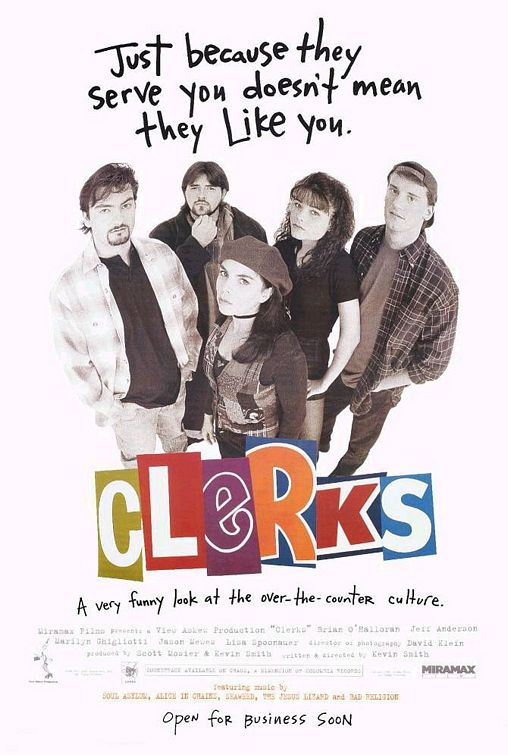
So something had to start me on that path, right? I can think of many non-comedian things that influenced me, but I am going to choose one for the purposes of this blog. And I would like YOU, the comedian reader, to comment and leave an influence that helped mold you; anything that isn’t a comedian. Write about: a cartoon, a relative, a show, a book, a movie, a musician, an event, a comic strip, or anything that helped make you who you are. For myself I have chosen the movie Clerks.

[Read the rest, or just jump to the part where you get to talk.]


Now a lot of people don’t like Kevin Smith, but that’s not important. This isn’t about my love of Kevin Smith, it’s about how, growing up, I watched the movie Clerks. When I was around 10 years old, I hung out at my friend Nick’s house close to every single weekend for about 5-6 years (free Sunny D). We would practice flips on sofa cushions and play Super Nintendo till our eyes bled pixels. And at night we would set up the TV and watch movies until we fell asleep. Nick only owned three R rated movies: Terminator 2, Highlander 2, and Clerks. I can say with all certainty that I have seen all three of these movies in the hundreds. I cannot watch any of these movies now, because now not only do I know how Terminator 2 ends I know how many times Sarah Connor blinks when the Psych Ward guard licks her face (trick question. None!). It might also interest you to know I watched Highlander 2 and Terminator 2 all those times without ever having once seen the first movies in those series. I am that cool.

So, back to Clerks. I loved this movie. It’s basically a movie where nothing happens except people talking and I, a 10 year old, was totally engrossed. Every time. I barely understood a third of what they were saying (raised Catholic, very naïve, scared of own dick) but I kept watching. Over those 6 years I understood more and more of the movie and began to appreciate it for different reasons. I think the important thing I took from that movie was the foul language.

I am completely sincere. That movie taught me how to swear. It changed how I made kids laugh. Now I wasn’t just silly, but could say things that would elicit laughter. It set me on a path of passion for the well crafted sentence. When I listen to Patton Oswalt the best thing I take away from it is how he sets up his adjectives and adverbs like a composer. It’s not what you say; it’s how you say it.

Clerks also taught me the value of minimalism. It’s about relationships and nuances. It’s the details of life that make life interesting. Like I said, the story is very low key, but when you watch it go down it seems like all life depends on the end of that day. Now I admit, Clerks is not even the best example of these ideas, and when I watch it today I almost cringe, but at that time and place in my life it was a big deal. That’s the real deal Holyfield.

Please share your personaly abused muse.

Show us on the blog where they touched you!

Read more!